

Why Are My Right and Left Glasses Prescriptions Different?
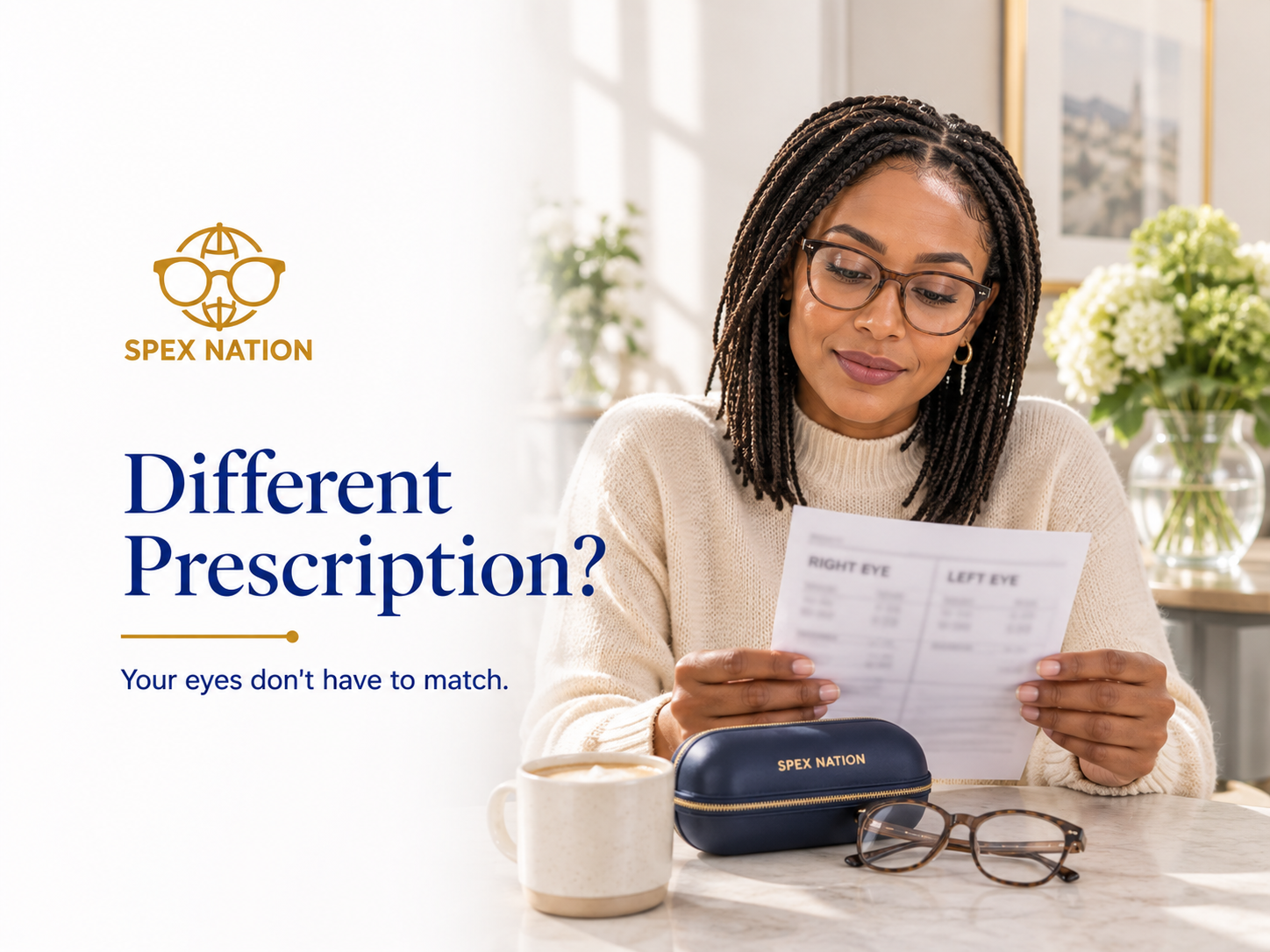
Take a look at your glasses prescription and you might notice something interesting.
The numbers for your right eye and left eye aren't necessarily the same.
One eye might have a stronger SPH value. One could have more astigmatism. You might even have CYL and AXIS measurements for one eye but not the other.
Is that normal?
Yes. Your two eyes don't have to have identical prescriptions.
Each eye is measured separately
Although your eyes work together to create your overall vision, they're two separate eyes.
Each can have its own refractive error.
That's why a spectacle prescription normally has separate measurements for the right and left eyes.
You may see these identified as R and L, or sometimes OD and OS.
Why can one eye be stronger?
The physical and optical characteristics of your two eyes aren't necessarily identical.
Small differences between them can result in different amounts of short-sightedness, long-sightedness or astigmatism.
For example, one eye could have a SPH of -1.00 while the other is -2.00.
That simply means the two eyes require different lens powers to provide the prescribed correction.
Do both lenses in my glasses get made differently?
If the prescriptions are different, yes.
Each lens is made according to the prescription for the eye it sits in front of.
Your right lens therefore doesn't automatically have the same power as your left lens.
From the outside, the glasses may look almost identical even though the two lenses have different prescriptions.
Can one eye have astigmatism and the other not?
Yes.
One eye might have a CYL and AXIS measurement while the other has little or no cylindrical correction.
Both eyes could also have astigmatism but require different amounts of correction.
Again, the two eyes are assessed individually.
What if the difference is large?
Some people have only a tiny difference between their eyes.
Others have a much more noticeable difference.
When there is a significant difference in refractive power between the two eyes, the term anisometropia may be used.
How noticeable this is to the person varies considerably.
Can different prescriptions affect lens thickness?
They can.
If one eye has a stronger prescription, the corresponding lens may have a different thickness or appearance.
The effect depends on factors including the type and strength of the prescription, lens index, frame dimensions and how the lenses are positioned within the frame.
This means one lens can sometimes look slightly different from the other even though they're fitted into the same frame.
Do your eyes still work together?
Usually, yes.
Your brain receives visual information from both eyes and combines it.
The purpose of putting the appropriate prescription in front of each eye is to provide the correction each one requires.
Having different prescription numbers doesn't automatically mean the eyes can't work together.
Can the difference change over time?
Yes.
Your right and left eyes don't necessarily change at exactly the same rate.
One eye may remain relatively stable while the prescription in the other changes.
That's one reason your latest prescription should be used when ordering new glasses rather than assuming the values will be the same as an older prescription.
Don't copy one eye's numbers to the other
When entering a prescription online, pay particular attention to the RIGHT and LEFT columns.
It's easy to assume similar-looking numbers are interchangeable.
They're not.
Enter the values exactly as they're written for each eye, including any plus or minus signs.
If CYL and AXIS are present, make sure those measurements are also entered against the correct eye.
Different doesn't mean abnormal
People sometimes expect their eyes to be perfectly symmetrical.
In reality, differences between the right and left prescription are common.
Your spectacle prescription simply records the correction prescribed for each eye individually.
So if you notice that one side of your prescription looks stronger than the other, it doesn't automatically mean something is wrong.
It may simply mean your two eyes need slightly different lenses to help them see clearly.