

What Is Pupillary Distance (PD) and Why Does It Matter?
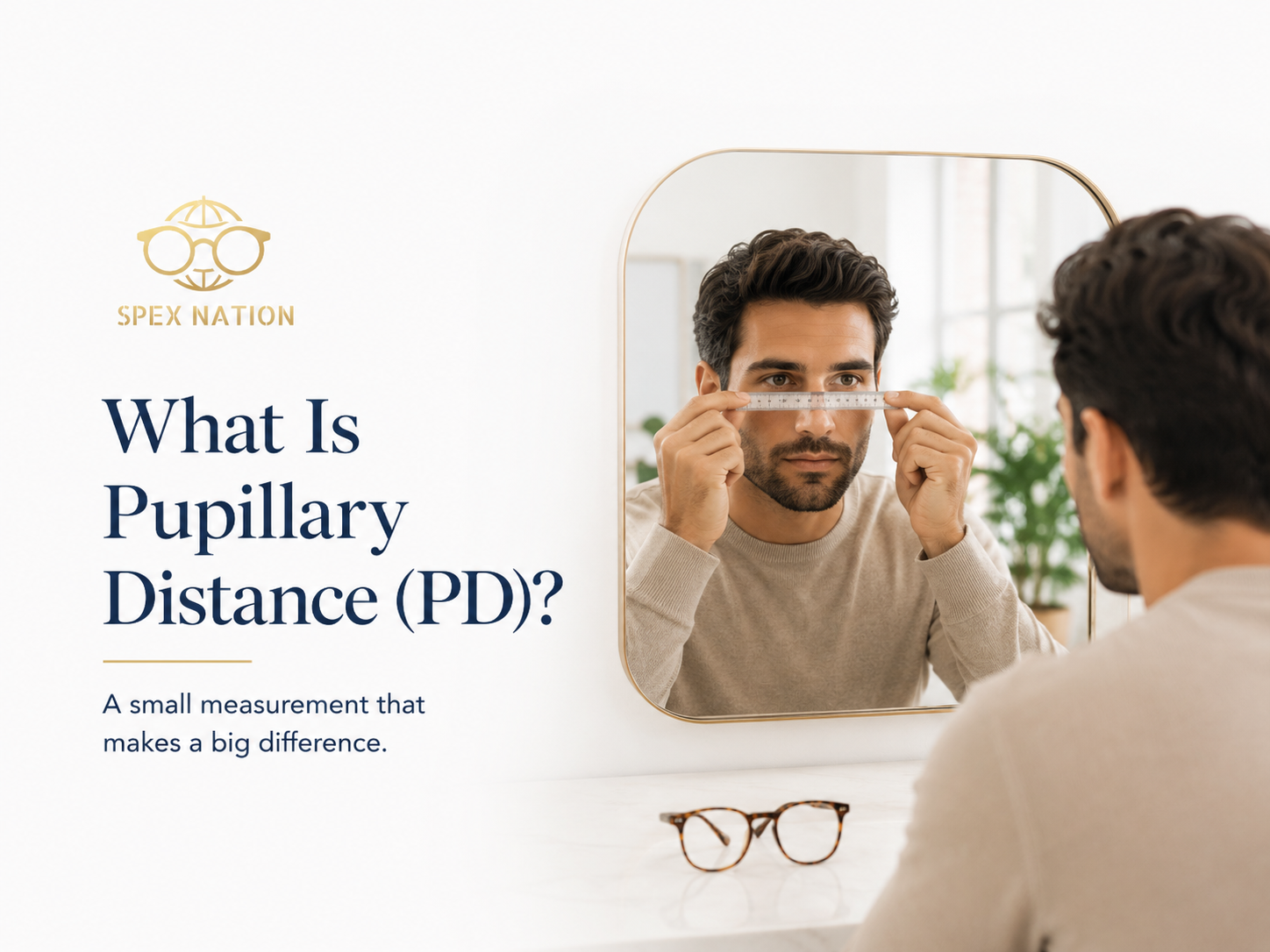
If you've ever ordered prescription glasses online, you've probably come across the term "PD". It stands for Pupillary Distance and, although it's only a simple measurement, it plays a big role in how comfortable and clear your glasses will be.
Understanding what PD is can help you order your next pair with confidence.
## What is Pupillary Distance?
Pupillary Distance (PD) is the distance, measured in millimetres, between the centres of your pupils.
This measurement tells the lenses where your eyes naturally look through them. When the optical centres of the lenses line up correctly with your pupils, you'll enjoy the clearest and most comfortable vision.
## Why is PD important?
Even with the correct prescription, glasses may not perform as well if the PD is incorrect.
A correct PD helps to:
• Keep your vision sharp.
• Reduce unnecessary eye strain.
• Improve comfort throughout the day.
• Ensure you look through the centre of each lens.
Small differences may not always be noticeable, but larger errors can affect how comfortable your glasses feel.
## Is PD included on every prescription?
Not always.
In the UK, your prescription contains the information needed to make your lenses, but PD is not always written down.
If you don't already know your PD, there are several ways to obtain it before ordering glasses online.
## Can I measure my own PD?
Yes. Many people measure their own PD using a millimetre ruler and a mirror, or by asking someone to help.
There are also digital measuring tools available that can assist with obtaining an accurate reading.
If you're unsure of your measurement, it's worth checking it more than once for consistency.
## Single PD and Dual PD
You may come across two different formats.
Single PD
A single number, such as 63 mm, measures the total distance between both pupils.
Dual PD
Two numbers, such as 31.5 mm and 31.5 mm, measure the distance from the centre of your nose to each pupil individually.
Both formats can be used to produce prescription lenses, depending on the information requested.
## Does PD change?
For most adults, PD changes very little once facial growth is complete.
Children's PD can change as they grow, so measurements may need updating over time.
## Ordering prescription glasses online
Before placing an order, make sure your prescription is up to date and that you have an accurate PD measurement.
Having both pieces of information helps ensure your lenses are made correctly and fit your eyes as intended.
At SpexNation, providing the correct prescription details and PD helps us produce single vision prescription glasses that offer clear, comfortable vision from the moment you put them on.