

How to Measure Your Pupillary Distance (PD) at Home
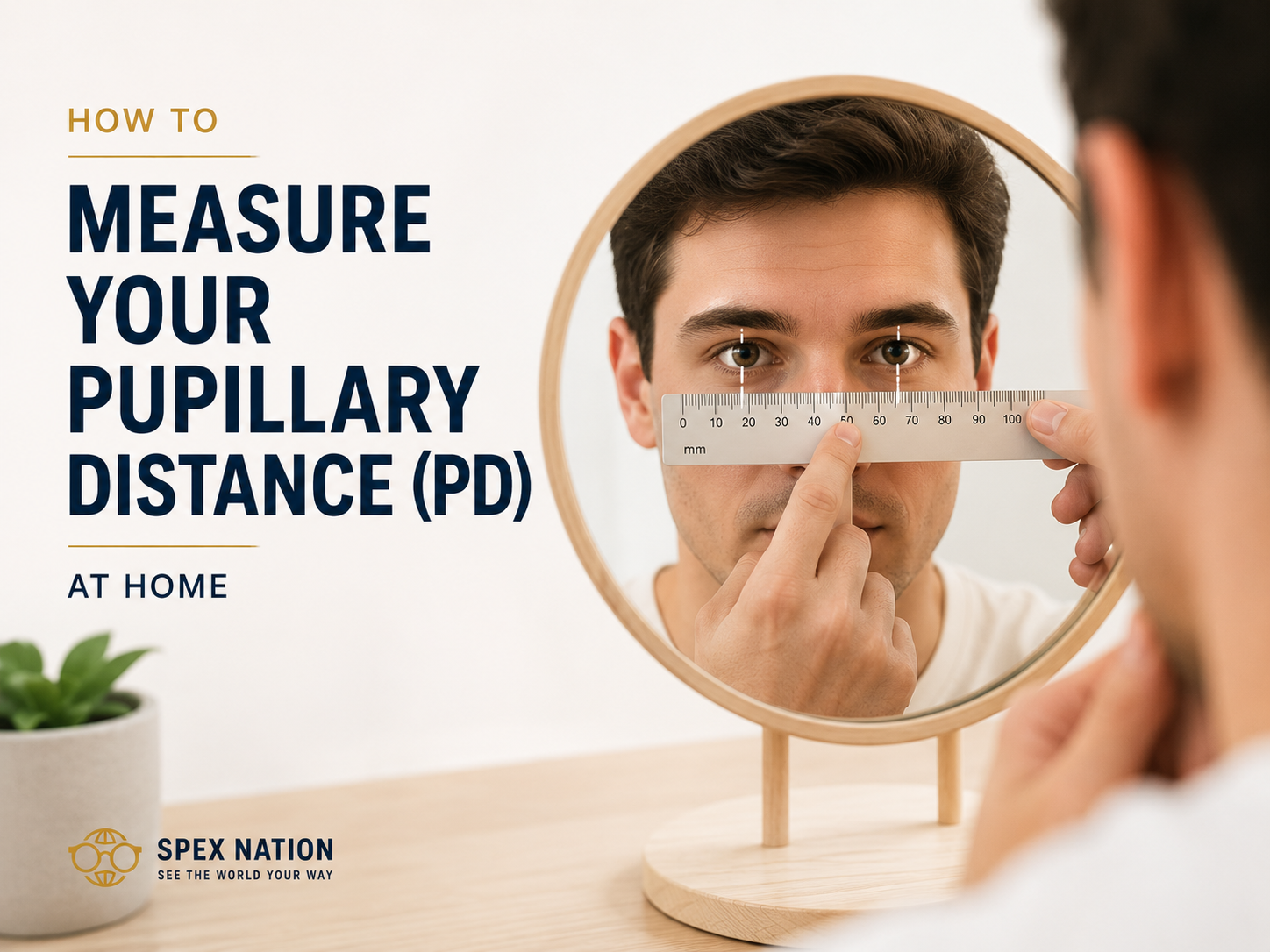
How to Measure Your Pupillary Distance (PD) at Home
If you're ordering prescription glasses online, you'll often be asked for your Pupillary Distance (PD). While it might sound technical, it's simply a measurement that helps ensure your lenses are positioned correctly in front of your eyes.
Getting your PD right can make a noticeable difference to how comfortable your new glasses feel.
What Is Pupillary Distance?
Pupillary Distance, often shortened to PD, is the distance between the centres of your pupils, measured in millimetres.
This measurement helps place the optical centre of each lens directly in front of your eyes, giving you the clearest and most comfortable vision.
Why Is PD Important?
Even if your prescription is entered correctly, an incorrect PD can affect how your glasses perform.
An inaccurate measurement may lead to:
• Eye strain
• Blurred vision
• Difficulty focusing
• Headaches
Taking a few extra minutes to measure your PD carefully can help avoid these problems.
How to Measure Your PD at Home
You can measure your PD with a millimetre ruler and a mirror.
1. Stand around 20 cm from a mirror in good lighting.
2. Hold the ruler against the bridge of your nose.
3. Close your right eye and align the zero mark with the centre of your left pupil.
4. Without moving the ruler, open your right eye and close your left eye.
5. Read the measurement at the centre of your right pupil.
This number is your distance PD.
For the most accurate result, repeat the measurement a few times and use the average.
Can Someone Else Measure It?
Yes.
Many people find it easier if a friend or family member measures their PD while they look straight ahead at a distant object.
This often provides a more accurate result than measuring in a mirror.
What Is a Typical PD?
Most adults have a PD somewhere between 54 mm and 74 mm.
Children usually have a smaller measurement.
Your exact PD is unique to you and should always be measured rather than guessed.
Can I Find My PD on My Prescription?
Not always.
Some optometrists include it, while others don't because it's primarily needed when dispensing glasses rather than carrying out the eye examination itself.
If it isn't listed, you can measure it yourself or ask your optician if they have it on record.
Tips for Accurate Results
To improve accuracy:
• Measure in good lighting.
• Keep the ruler level.
• Look straight ahead.
• Repeat the measurement several times.
• Ask someone else to measure if possible.
A small difference of 1 mm is usually not a major concern, but taking care with your measurement will help ensure the best possible fit.
Getting the Best Vision
Your prescription tells the lenses how to correct your eyesight, while your PD tells the lenses where to position that correction.
Both measurements work together to provide clear, comfortable vision.
If you're ordering glasses online, taking the time to measure your PD accurately is one of the simplest ways to help ensure your new glasses perform exactly as they should.