

AI Virtual Try-On Glasses: Can Technology Help You Find the Perfect Frames?
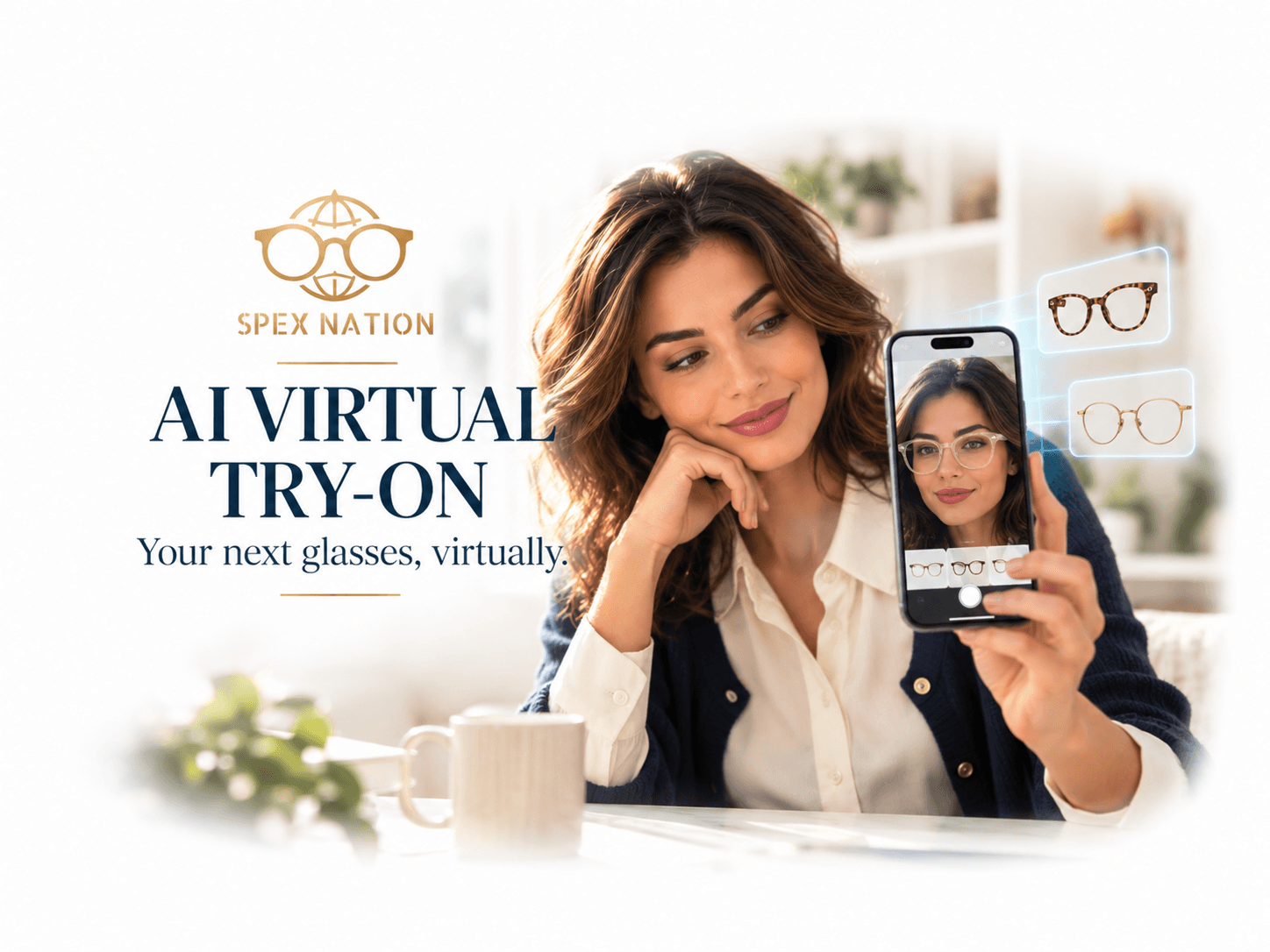
Buying glasses online has one obvious challenge: how do you know whether a frame will suit you before you've actually tried it on?
For years, shoppers relied on product photographs, frame measurements and a little imagination.
Now, artificial intelligence and augmented reality are introducing a different approach.
Virtual try-on technology allows people to see a digital representation of glasses on their own face using a smartphone or computer.
Some systems can even analyse facial measurements and suggest suitable frame styles.
But how does this technology actually work, and can it help you choose glasses with confidence?
1. What Is Virtual Try-On Technology?
Virtual try-on technology allows shoppers to preview how a pair of glasses might look on their face without physically wearing them.
Depending on the system, it may use a live camera feed or an uploaded photograph.
The software identifies important facial features, such as the position of the eyes, nose and ears, before placing a digital model of the glasses over the image.
More advanced systems use three-dimensional modelling to adjust the frame as the person moves their head.
This can create a surprisingly realistic preview.
However, the accuracy depends on the quality of the software, camera and digital frame model.
2. How Does AI Improve Virtual Try-On?
Artificial intelligence can help make virtual try-on systems more sophisticated.
Traditional systems primarily overlay a digital frame onto an image.
AI-assisted technology may also analyse facial landmarks, estimate proportions and improve how virtual frames align with the face.
Some platforms use machine learning to recommend styles based on facial characteristics or previous shopping behaviour.
For example, a system might suggest different frame widths or shapes based on its analysis.
However, these recommendations should be treated as guidance rather than definitive measurements or professional fitting advice.
3. Can You Really Try On Glasses Using Your Phone?
Yes.
Many virtual try-on systems work through a smartphone camera.
The process typically involves selecting a frame, allowing camera access and positioning your face within the on-screen guide.
The software then places a digital version of the glasses over your face.
Some systems allow you to turn your head and view the frames from different angles.
Others provide a static preview using a photograph.
The quality of the experience varies between retailers and platforms.
Good lighting, a clear camera image and accurate digital frame models can all improve the result.
4. Can Virtual Try-On Tell You Which Glasses Suit Your Face?
It can help you compare appearances, but personal style remains subjective.
Virtual try-on is particularly useful for exploring different frame shapes.
For example, you could compare:
Round frames
Rectangular glasses
Cat-eye designs
Oversized acetate frames
Thin metal glasses
Transparent frames
Seeing these styles on your own face can make it easier to decide which designs you prefer.
However, there is no single scientifically correct frame shape for every face.
Comfort, proportions and personal preference are often more important than following rigid face-shape rules.
5. How Accurate Is Virtual Try-On?
This is one of the most important questions.
Virtual try-on can provide a useful visual impression, but it doesn't always reproduce the exact size or fit of physical glasses.
Several factors can affect accuracy.
Camera perspective
A camera positioned too close to the face can distort proportions.
Frame scaling
If the system doesn't have reliable facial measurements, the displayed frame may appear larger or smaller than it would in reality.
Digital modelling
Some virtual frames are more accurately represented than others.
Lighting
Reflections, transparency and colour can appear different on a screen.
Physical fit
A digital preview cannot reliably show how a frame will feel against your nose or behind your ears.
For these reasons, virtual try-on should be viewed as a helpful shopping tool rather than a guarantee of fit.
6. Can AI Measure Your Pupillary Distance?
Some digital tools attempt to estimate pupillary distance, commonly known as PD, using a smartphone camera.
PD is the distance between the centres of the pupils and is used when positioning prescription lenses.
Accurate measurements are important for ensuring the lenses are correctly aligned.
However, not all camera-based measurement systems offer the same level of accuracy.
Results can be influenced by camera calibration, positioning, lighting and the measurement method.
For prescription eyewear, it's important to use a reliable PD measurement rather than assuming a virtual try-on preview has measured it accurately.
7. Can Virtual Try-On Replace Visiting an Optician?
Not completely.
Virtual try-on technology is designed primarily to help shoppers visualise eyewear.
It doesn't replace a comprehensive eye examination or professional assessment of visual needs.
An optometrist can assess eye health, determine an appropriate prescription and identify issues that a virtual shopping tool cannot detect.
A dispensing professional can also assess physical frame fit, lens positioning and suitability.
Virtual try-on is therefore best understood as an additional shopping aid rather than a replacement for professional eye care.
8. Why Is This Technology Becoming Popular?
Convenience is one of the biggest attractions.
People increasingly expect to compare products online before making a purchase.
Virtual try-on reduces some of the uncertainty associated with choosing frames from photographs alone.
It can also make browsing more engaging.
Instead of imagining how a pair of glasses might look, shoppers can see a digital preview immediately.
For online eyewear retailers, this technology has the potential to improve the shopping experience.
However, its effectiveness depends on how accurately it represents real products.
9. Could AI Eventually Recommend Your Perfect Glasses?
Future eyewear shopping systems may combine several types of information.
These could include:
Facial measurements
Frame dimensions
Prescription requirements
Previous purchases
Personal style preferences
Virtual try-on feedback
Such systems might help narrow down a large selection of frames to a smaller number of potentially suitable options.
But even sophisticated recommendations would still need to account for personal preference and physical comfort.
A frame that looks attractive on a screen isn't necessarily the one that feels best after several hours of wear.
10. What Are the Privacy Concerns?
Virtual try-on services often require access to facial images or live camera footage.
Because facial images can contain personal information, shoppers should understand how a platform handles their data.
Before using a virtual try-on service, consider checking:
Whether photographs are stored
How long images are retained
Whether images are shared with third parties
Whether facial data is used for other purposes
What privacy controls are available
Different platforms have different policies.
Using a reputable service and reviewing its privacy information can help you make an informed decision.
11. What Should You Check Before Buying Glasses Online?
Even when virtual try-on is available, several practical checks remain essential.
Frame measurements
Check the lens width, bridge width and temple length.
Your prescription
Ensure your prescription is current and suitable for the lenses you intend to order.
Pupillary distance
Provide an accurate PD measurement when required.
Lens options
Choose a lens material and index appropriate for your prescription.
Frame suitability
Consider whether the frame dimensions and design will work with your lenses.
Returns policy
Read the retailer's terms before ordering, particularly for prescription products.
These checks can be more useful than relying entirely on a digital preview.
12. Is AI the Future of Buying Glasses Online?
AI and augmented reality are likely to remain important areas of development in online eyewear shopping.
As cameras, digital modelling and facial measurement systems improve, virtual try-on experiences may become more realistic.
However, technology works best when it supports informed decisions rather than replacing them.
The ideal online eyewear experience combines clear product information, accurate measurements, appropriate prescription lenses and helpful visual tools.
Virtual try-on may make choosing glasses easier, but the fundamentals of good eyewear remain unchanged.
Discover Prescription Glasses at SpexNation
Technology is changing how people discover and compare eyewear, but choosing the right prescription glasses still comes down to style, fit and optical suitability.
At SpexNation, we offer a selection of prescription frames with single-vision lens options.
Although we don't currently provide an AI virtual try-on service, our product listings include frame information to help you compare different styles.
Whether you're looking for classic everyday glasses or something more distinctive, choosing the right measurements and lens options remains essential.
Explore prescription glasses at SpexNation and find a style that suits your everyday needs.